TL;DR
- Cold storage energy efficiency directly impacts your bottom line – electricity typically represents 9-18% of total operating revenue
- 8 proven strategies can reduce cold storage operating costs by up to 30%: VFD compressors (10-35% savings), LED lighting (50-75%), improved insulation (40-50%), high-speed doors (30-70%), smart refrigerants, EC fans, IoT monitoring, and advanced condensing systems
- Real-world case studies show Rs 11 lakh annual savings and 43% energy reduction through integrated upgrades
- Government subsidies cover 35-50% of costs under PMKSY cold chain scheme, plus additional support for renewable energy integration
- BEE Star Rating mandatory from January 2026 for new cold storage facilities in India
- Rinac’s 30+ years and 10,000+ projects deliver turnkey cold storage solutions with integrated energy efficiency measures
Introduction: Energy Efficiency in Cold Storage Matters More Than Ever
Cold storage energy efficiency has become mission-critical for facility owners and operators across India. The cold chain sector consumes over 4,800 MW of electricity daily, yet most facilities operate with significant energy waste. Whether you manage a 500-ton cold storage warehouse or a multi-chamber refrigeration facility, energy optimization directly impacts profitability. Electricity costs typically represent 9-18% of total operating revenue in cold storage, making energy efficiency optimization one of the highest-ROI investments you can make.
This comprehensive guide reveals eight proven strategies to reduce operating costs by up to 30% through strategic energy efficiency upgrades. From Variable Frequency Drive (VFD) compressors to intelligent IoT monitoring systems, these proven approaches have delivered measurable results across India’s cold chain industry.
Why Cold Storage Energy Efficiency Should Be Your Top Priority in 2026
The economics are compelling. In a typical cold storage facility, approximately 80% of electricity consumption comes from refrigeration systems. The remaining 20% is distributed among lighting, fans, controls, and auxiliary equipment. This concentration means strategic refrigeration upgrades deliver outsized energy savings.
Energy Cost Reality Check
- Electricity: 9-18% of total operating revenue
- Refrigeration: 80% of total electricity consumption
- Average facility: Rs 8-15 lakh annual electricity costs (a major factor in cold storage India cost calculations)
- Potential savings through efficiency: Rs 2.4-4.5 lakh annually
- Payback period: 18-36 months for most upgrades
Additionally, 2026 brings mandatory BEE Star Rating requirements for new cold storage facilities, making energy efficiency improvements not just economically prudent but also regulatory necessities. Government subsidies under the Pradhan Mantri Kisan Sampada Yojana (PMKSY) and other cold chain schemes now cover 35-50% of cold storage infrastructure costs, including energy-efficient equipment.
Cold Storage Energy Efficiency – 8 Proven Strategies to Cut Costs by 30%
These eight evidence-based strategies form an integrated approach to maximizing energy efficiency across your cold storage operations.
1. VFD Compressors – Save 10-35% on Refrigeration Energy
Variable Frequency Drive (VFD) compressors represent the single most impactful energy efficiency upgrade. Traditional fixed-speed compressors consume full power regardless of actual cooling demand, operating inefficiently during partial-load conditions – which comprises 60-70% of operational hours.
VFD compressor cold storage technology modulates compressor speed based on real-time temperature requirements, reducing power consumption proportionally and enabling significant cold room energy saving. In a facility maintaining -18°C with ambient temperatures rising to 35-40°C during summer, VFD compressors deliver the most dramatic energy savings precisely when energy costs peak.
Real-world results: A 500-ton capacity facility typically reduces refrigeration energy by 10-25% with basic VFD implementation, rising to 30-35% when combined with advanced controls and optimized setpoints.
2. LED Lighting – Cut Lighting Costs by 50-75%
Lighting in cold storage facilities operates 16-24 hours daily, creating substantial cumulative energy consumption. Cold room electricity consumption for lighting alone reaches 2-4 kW in medium-sized facilities, consuming 15,000-35,000 kWh annually.
LED technology specifically designed for cold environments delivers 50-75% energy reduction compared to traditional fluorescent or metal halide systems. Unlike standard LEDs, cold-rated LED fixtures maintain performance efficiency at sub-zero temperatures where traditional LEDs deteriorate in lifespan and output.
Dual benefits: Beyond cold storage energy efficiency gains, LED systems produce significantly less waste heat, reducing cooling load by 3-5%. A 500-ton facility upgrading to full LED coverage saves Rs 1.5-2.5 lakh annually while improving visibility and worker safety.
3. PUF/PIR Insulation Upgrades – Reduce Envelope Losses by 40-50%
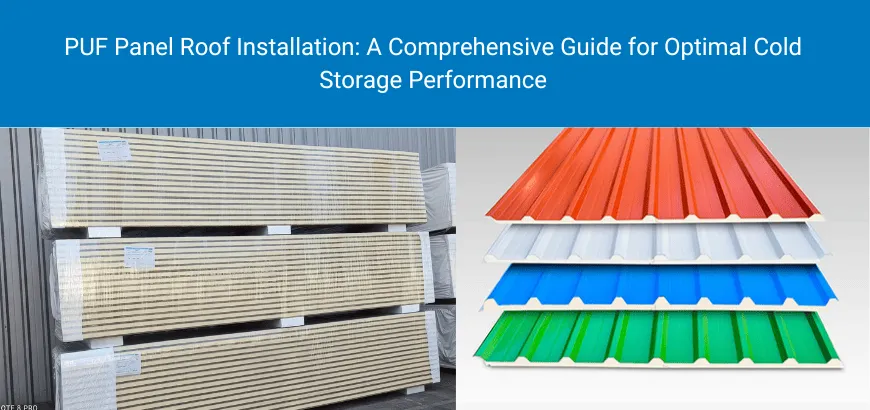
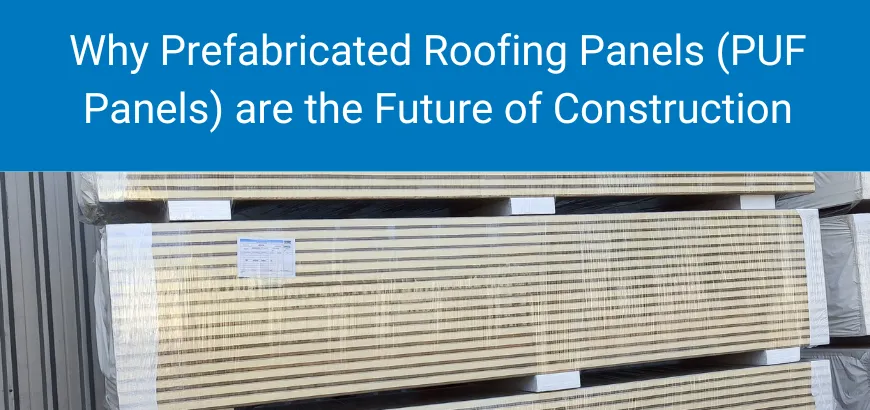
Thermal envelope integrity directly determines cooling efficiency. PUF panel insulation represents the gold standard for modern cold storage, offering 40-50% better insulation performance than traditional rockwool systems when properly installed.
The choice between PUF vs PIR vs Rockwool carries significant energy implications. In India’s high-ambient climate, PUF panels with 100-150mm thickness achieve thermal resistance (R-value) of 4.5-6.8 m²K/W, minimizing the heat gain that compressors must continuously counter.
Upgrading insulation in an existing facility involves strategic panel replacement or external retrofitting. While capital-intensive (Rs 500-800 per square meter), the energy payback period ranges from 3-4 years, with total facility savings of Rs 3-5 lakh annually through reduced refrigeration load.
4. High-Speed Automatic Doors – Slash Air Infiltration by 30-70%
Every door opening in a cold storage facility breaches the thermal envelope, allowing warmer air infiltration that the refrigeration system must immediately recool. Traditional manual swing doors create 30-60 second exposure windows, while even rapid-closing sliding doors allow 10-20 second infiltration periods.
High-speed roller shutter doors close in 0.5-1.5 seconds, reducing infiltration cycles and attendant energy waste by 30-70%. A single door opening in a standard chamber releases approximately 5-8% of conditioned air volume, making door management one of the most cost-effective energy-saving improvements.
Installation costs range from Rs 80,000-150,000 per door, with payback periods of 12-24 months through electricity savings alone, not accounting for improved food preservation, reduced spoilage, and lower labor requirements.
5. Ammonia vs Freon – Choose the Right Refrigerant
Refrigerant selection profoundly impacts cold storage operating cost through thermodynamic efficiency differences. Ammonia (NH3) offers superior energy efficiency compared to fluorinated refrigerants like R404A or R507, delivering 15-25% better COP (Coefficient of Performance) under typical operating conditions.
For new cold storage installations, ammonia-based systems should be the default choice where safety protocols (secondary loop systems, proper ventilation, staff training) allow comprehensive implementation. Cascade systems combining ammonia with secondary refrigerants in medium-temperature zones further optimize efficiency.
Existing facilities operating synthetic refrigerants should evaluate retrofit compatibility, particularly for equipment nearing end-of-life replacement. India’s F-Gas phasedown roadmap favors low-GWP alternatives including natural refrigerants, aligning environmental regulations with superior energy performance.
6. EC Fans – Reduce Fan Energy by 50-80%
Electronically Commutated (EC) fans represent a critical but often overlooked cold storage energy efficiency improvement. Evaporator fans in cold chambers and condenser fans in outdoor units typically operate at fixed speeds, consuming 20-30% of total facility electricity despite variable cooling demand.
EC fan technology modulates fan speed based on actual heat load requirements, delivering 50-80% energy reduction compared to fixed-speed AC motors. A 500-ton facility operating 24/7 saves approximately Rs 2-3 lakh annually through EC fan conversion, with payback periods under 18 months.
Additional benefits include reduced noise levels (valuable for worker-occupied areas), improved temperature uniformity within chambers through speed variation, and extended fan motor lifespan through softer starting and lower operating stresses.
7. Smart IoT Controls and Monitoring
Data-driven optimization separates efficient facilities from excellent ones. IoT-based monitoring systems track real-time energy consumption, temperature patterns, equipment performance, and control responsiveness, identifying inefficiencies invisible to traditional facility management.
Smart controls automatically optimize setpoints based on ambient temperature, time-of-use electricity rates, and product load characteristics. Machine learning algorithms detect performance degradation (dirty condenser coils, refrigerant leaks, control drift) weeks before failures occur, maintaining peak efficiency throughout equipment lifespan.
Implementation costs range from Rs 3-8 lakh for full facility coverage, delivering 5-15% electricity savings through optimized operations plus substantial O&M cost reductions through predictive maintenance. Contact our cold chain experts for customized IoT system designs.
8. Evaporative Condensing vs Air-Cooled Systems
Condenser efficiency directly affects compressor discharge pressure and system COP. In India’s hot and dry climate, evaporative condensing systems deliver substantially higher efficiency than traditional air-cooled condensers, particularly during summer months when cooling loads peak.
Evaporative condensers reduce refrigerant discharge temperature by leveraging ambient wetbulb depression, lowering system pressure drop and compressor energy requirements by 15-20% compared to air-cooled equivalents in standard operating conditions. Water consumption (approximately 2-5 liters per ton of refrigeration daily) represents a minor environmental and cost consideration compared to energy savings.
Real-world case studies demonstrate that combining evaporative condensing with subcooling heat exchangers delivers cumulative 43% energy reduction compared to baseline air-cooled systems, representing the single most powerful systems-level efficiency improvement available.
Real-World Cold Storage Energy Efficiency Results in India
Theory becomes credible only when validated by practical results. Here are documented cases demonstrating measurable cold storage energy efficiency improvements across India’s cold chain sector.
Case Study: Bhusari Cold Storage, Bihar – 100 kWp Solar + Energy Efficiency Integration
Facility: 500-ton capacity cold storage in Agampur, Bihar
Challenge: Rs 18 lakh annual electricity cost under traditional operation
Solution: 100 kWp rooftop solar system with VFD compressor upgrades, LED lighting conversion, and evaporative condenser installation
Results: Year 1 savings of Rs 11 lakh through combined renewable energy generation and operational efficiency improvements, with additional 40% reduction in grid electricity consumption during peak solar production hours
Case Study: Multi-Facility Energy Reduction Study
Scope: 15 cold storage facilities across Maharashtra and Andhra Pradesh
Baseline: Average energy intensity 850 kWh per ton annual capacity
Implementation: Subcooling heat exchangers + evaporative condensers (43% improvement), enhanced monitoring and controls (12% optimization)
Result: Comprehensive 16.4% total energy reduction, equivalent to Rs 3.2-4.8 lakh annual savings per facility
These documented results underscore a fundamental principle: integrated approaches combining multiple efficiency measures deliver exponentially greater results than single-technology implementations. The 30% overall reduction target becomes achievable when cold storage operators sequence investments strategically across refrigeration systems, thermal envelope, lighting, and controls.
Government Subsidies for Energy Efficient Cold Storage in India
India’s policy framework actively encourages cold storage energy efficiency upgrades through substantial financial incentives. Understanding these programs is critical for optimizing project ROI.
Primary Government Support Programs
Pradhan Mantri Kisan Sampad Yojana (PMKSY)
- 35-50% subsidy on cold storage infrastructure capital costs
- Maximum subsidy: Rs 10 crore per project
- Covers pre-cooling facilities, cold storage chambers, and material handling systems
- Application through state agricultural ministries
Renewable Energy Integration Support
- Additional Rs 35 lakh for solar/renewable energy systems
- Coordinated with PMKSY base subsidy programs
- Eligibility through dedicated renewable energy schemes
BEE Star Rating – Mandatory from January 2026
- All new cold storage facilities above 10,000 m³ capacity must achieve minimum 3-star rating
- Rating criteria includes energy intensity, insulation standards, and refrigeration system efficiency
- Energy-efficient designs receive preferential treatment in subsidy approvals
Mission for Integrated Development of Horticulture (MIDH)
- 50% subsidy for cold chain infrastructure benefiting farmers and agricultural producers
- Lower minimum project scale than PMKSY
- Regional focus on horticultural producing areas
Access our comprehensive cold chain subsidy guide for detailed application procedures and regional eligibility criteria. Properly structured projects combining multiple subsidy programs can reduce net capital investment by 60-70% while achieving maximum energy efficiency standards.
How Rinac Helps You Achieve Maximum Cold Storage Energy Efficiency
Rinac India Limited brings 30+ years of cold chain expertise, 10,000+ completed projects, and 6,000+ satisfied clients to every cold storage engagement. Our integrated approach positions energy efficiency as a core design principle rather than an afterthought, delivering measurable results across facility operations.
Comprehensive Design Methodology: Our engineering team begins every project with detailed energy audits establishing baseline consumption, identifying loss mechanisms, and prioritizing interventions based on ROI impact. We design integrated systems where each component – refrigeration, insulation, lighting, controls, and structural elements – optimizes energy performance holistically rather than in isolation.
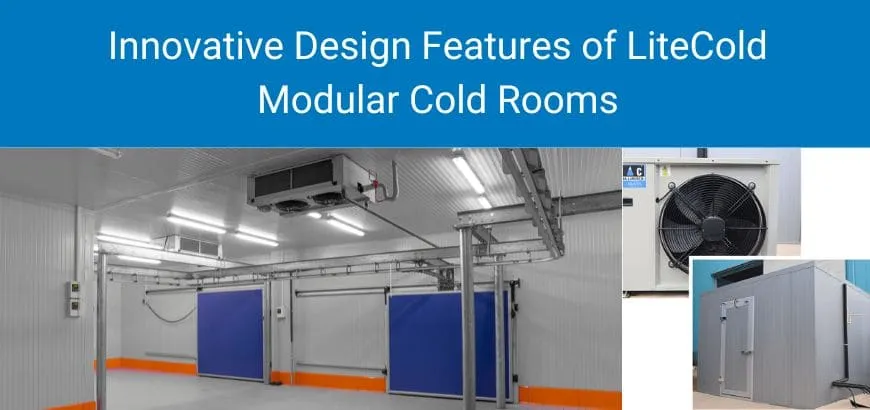
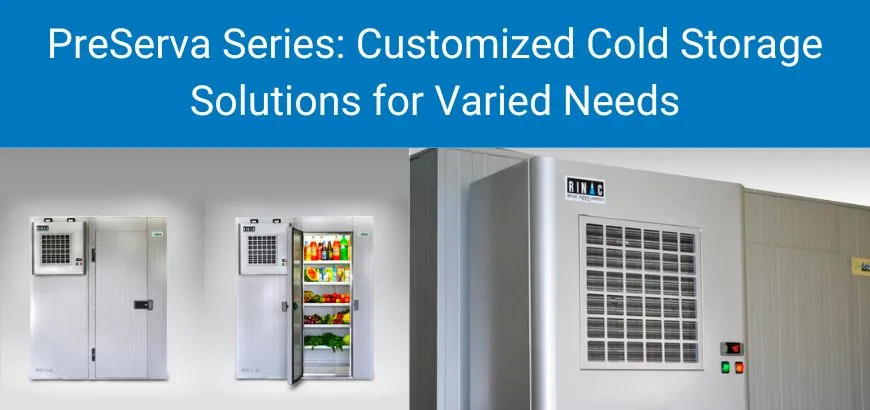
Premium Building Materials: We specify PreServa cold room solutions featuring optimized PUF panel insulation configurations and our proprietary LiteCold modular room technology, reducing thermal loss by 40-50% compared to conventional constructions. Material selection emphasizes durability and performance consistency across decades of operation.
Advanced Refrigeration Systems: Our refrigeration systems integrate VFD compressors, EC fans, evaporative condensers, and smart IoT controls as standard components. We eliminate inefficient fixed-speed equipment, instead configuring systems that modulate performance based on real-time operating conditions.
Turnkey Project Execution: From feasibility analysis through operational commissioning, Rinac manages complete cold storage development including engineering and construction solutions. We coordinate subsidy applications, manage regulatory compliance (ISO, FSSAI, HACCP certifications), and train operations teams for optimal facility performance.
Ongoing Optimization Support: Cold storage energy efficiency extends beyond installation. Our predictive monitoring systems continuously analyze performance data, identify degradation patterns, and recommend maintenance interventions before efficiency losses occur. This proactive approach maintains peak performance throughout equipment lifespan.
Comparative Energy Efficiency Improvements by Technology
This table summarizes the energy impact, estimated ROI payback periods, and implementation complexity for each major cold storage energy efficiency strategy:
| Technology | Energy Savings | ROI Payback | Implementation Complexity |
|---|---|---|---|
| VFD Compressors | 10-35% | 18-30 months | Medium |
| LED Lighting | 50-75% | 12-18 months | Low |
| Insulation Upgrades (PUF/PIR) | 40-50% | 36-48 months | High |
| High-Speed Doors | 30-70% | 12-24 months | Medium |
| EC Fans | 50-80% | 12-18 months | Medium |
| Smart IoT Controls | 5-15% | 24-36 months | Medium |
| Evaporative Condensing | 15-20% | 24-36 months | High |
| Integrated Approach (All Technologies) | 30-45% | 28-40 months | High |
8 proven strategies for improving cold storage energy efficiency and reducing operating costs.
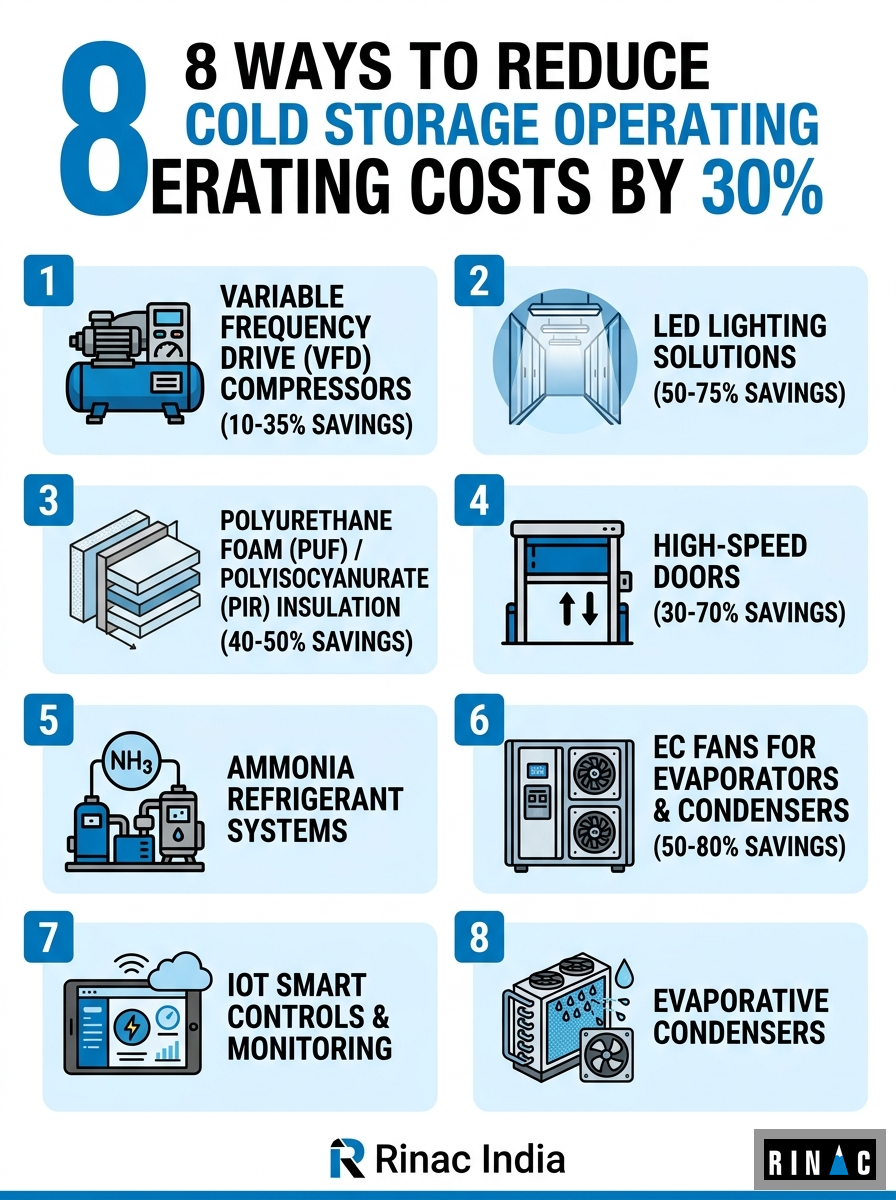
8 proven strategies for improving cold storage energy efficiency and reducing operating costs by 30%.
Frequently Asked Questions – Cold Storage Energy Efficiency
How can I improve energy efficiency in my facility?
Cold storage energy efficiency improvements follow a prioritized sequence based on ROI impact. Begin with comprehensive energy auditing to identify baseline consumption and loss mechanisms. Quick wins include LED lighting conversion (12-18 month payback), high-speed door installation (12-24 month payback), and control system optimization (24-36 month payback). Sequential capital projects addressing refrigeration system upgrades (VFD compressors, EC fans), thermal envelope improvements, and advanced condensing systems follow, with combined implementation delivering 30% total cost reduction.
What is the average electricity consumption of a cold storage warehouse in India?
Cold room electricity consumption varies significantly based on facility size, chamber temperature setpoints, ambient climate, and operational efficiency. A typical medium-scale 500-ton capacity facility operating at -18°C in India’s average climate consumes approximately 400,000-500,000 kWh annually, equivalent to 800-1000 kWh per ton of installed capacity yearly. This translates to monthly electricity costs of Rs 60,000-100,000 under current tariffs, representing 9-18% of total operating costs. Energy-efficient facilities achieve 30-40% reduction, operating at 560-700 kWh per ton annually.
How much can VFD compressors save on cold storage operating costs?
VFD compressors represent the single most impactful refrigeration upgrade for energy optimization in cold storage. Energy savings range from 10% in facilities already operating efficient refrigeration, to 25-35% in facilities with fixed-speed equipment running at partial load. A 500-ton facility upgrading to VFD compressors saves approximately Rs 2.5-4.5 lakh annually (based on 25-35% energy reduction), with payback periods of 18-30 months. When combined with advanced controls optimizing setpoints and load management, VFD savings extend toward the 35% ceiling.
What government subsidies are available for energy efficient cold storage in India?
India’s primary cold storage subsidy program is the Pradhan Mantri Kisan Sampad Yojana (PMKSY), which covers 35-50% of infrastructure capital costs with a maximum subsidy of Rs 10 crore per project. Additional Rs 35 lakh support is available for renewable energy integration (solar systems). The Mission for Integrated Development of Horticulture (MIDH) provides 50% subsidies for cold chain projects benefiting agricultural producers. Effective January 2026, all new cold storage facilities above 10,000 m³ must achieve BEE Star Rating certification. Detailed subsidy application procedures are available through state agricultural ministries and Rinac’s project development team.
What is the ROI payback period for cold storage energy efficiency upgrades?
ROI payback periods vary significantly by technology and facility operating parameters. Quick-payback technologies include LED lighting conversion (12-18 months), high-speed doors (12-24 months), and EC fan upgrades (12-18 months). Medium-payback improvements include VFD compressor retrofits (18-30 months) and smart IoT control systems (24-36 months). Capital-intensive upgrades like thermal envelope improvements (36-48 months) and evaporative condensing systems (24-36 months) require longer payback horizons. Integrated approaches combining multiple technologies sequentially achieve overall payback periods of 28-40 months, factoring subsidy support that reduces net capital requirements by 35-50%. Over 10-year facility lifespans, comprehensive cold storage energy efficiency upgrades deliver cumulative net present value benefits exceeding Rs 15-25 lakh per 500-ton facility.
Ready to Achieve 30% Energy Cost Reduction?
Our energy efficiency experts conduct comprehensive audits identifying your facility’s highest-impact improvement opportunities. Discover how integrated upgrades transform operating costs and deliver regulatory compliance simultaneously.
Explore Cold Storage Solutions Optimized for Energy Efficiency
Rinac’s cold room solutions integrate efficiency-focused design from conception, combining PreServa modular construction with advanced refrigeration systems. Learn how our 30+ years of expertise creates measurable operational advantages.
Related Cold Storage Reading
- Complete guide to starting a cold storage business in India
- Walk-in chillers vs freezers: Complete buyers and operators guide
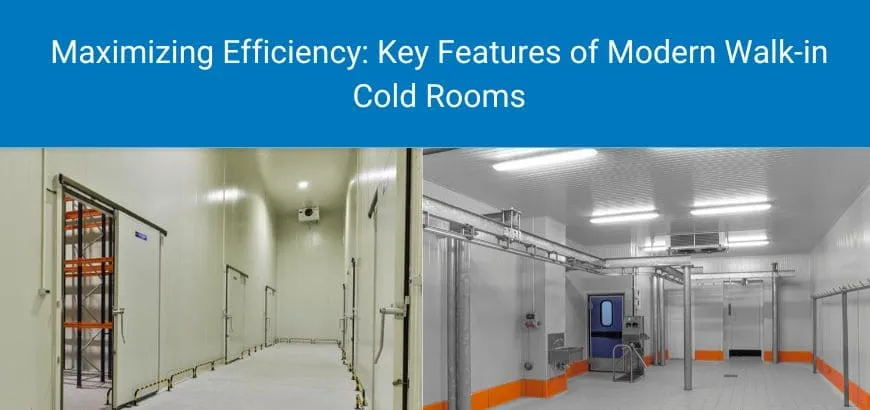
- Maximizing efficiency: Key features of modern walk-in cold rooms
- What is a cold storage warehouse and how does it work?
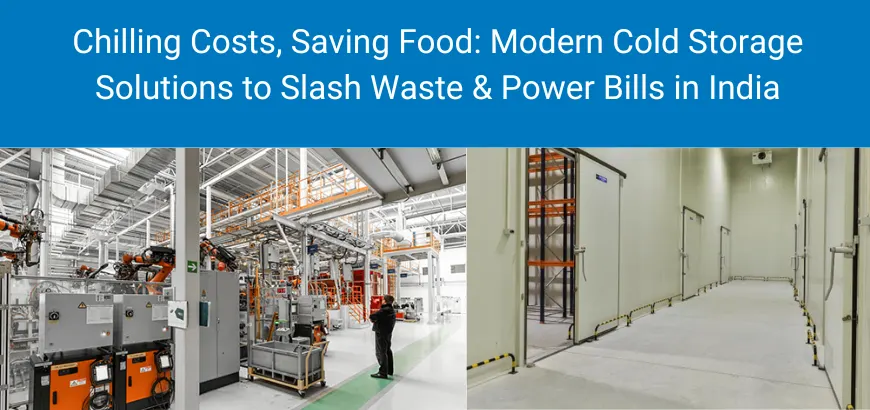
- Reducing waste and power bills: Modern cold storage solutions
- Ensuring FSSAI compliance in cold storage operations
Conclusion: Cold Storage Energy Efficiency as Strategic Competitive Advantage
Cold storage energy efficiency has evolved from a nice-to-have operational concern to a critical competitive differentiator and regulatory mandate. The eight proven strategies outlined in this guide deliver measurable, documented results across India’s cold chain sector. More importantly, these improvements compound – integrated approaches combining VFD compressors, LED lighting, improved insulation, high-speed doors, smart controls, and advanced condensing systems achieve 30-45% total cost reduction, positioning energy-efficient facilities for sustained profitability in an increasingly cost-competitive cold chain market.
Government subsidies covering 35-50% of infrastructure costs eliminate financial barriers to implementation. Mandatory BEE Star Rating requirements from January 2026 ensure that cold storage energy efficiency becomes a baseline design criterion rather than an afterthought. Facility operators who prioritize efficiency today position themselves optimally for tomorrow’s regulatory landscape and operational economics.
Rinac India Limited stands ready to architect your facility’s energy transformation, leveraging 30+ years of expertise, 10,000+ completed projects, and proven technologies delivering documented 30% cost reductions. Whether you’re developing new capacity or optimizing existing operations, our comprehensive approach ensures maximum efficiency, regulatory compliance, and sustainable profitability. Contact our cold chain experts today to begin your energy efficiency journey.
Transform Your Cold Storage Operations Today