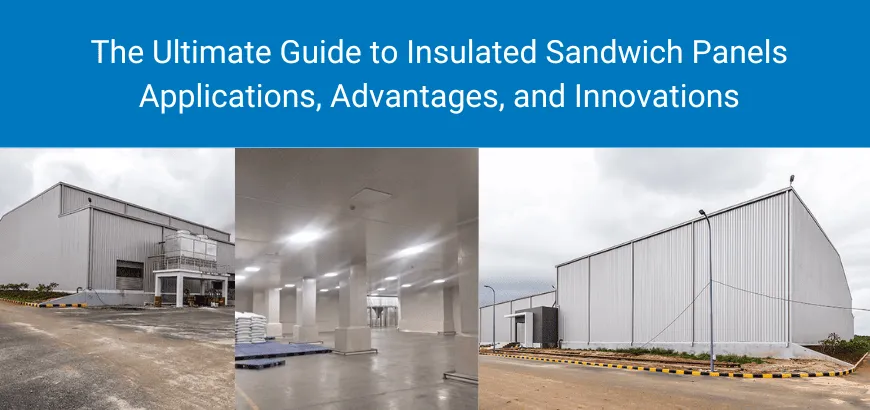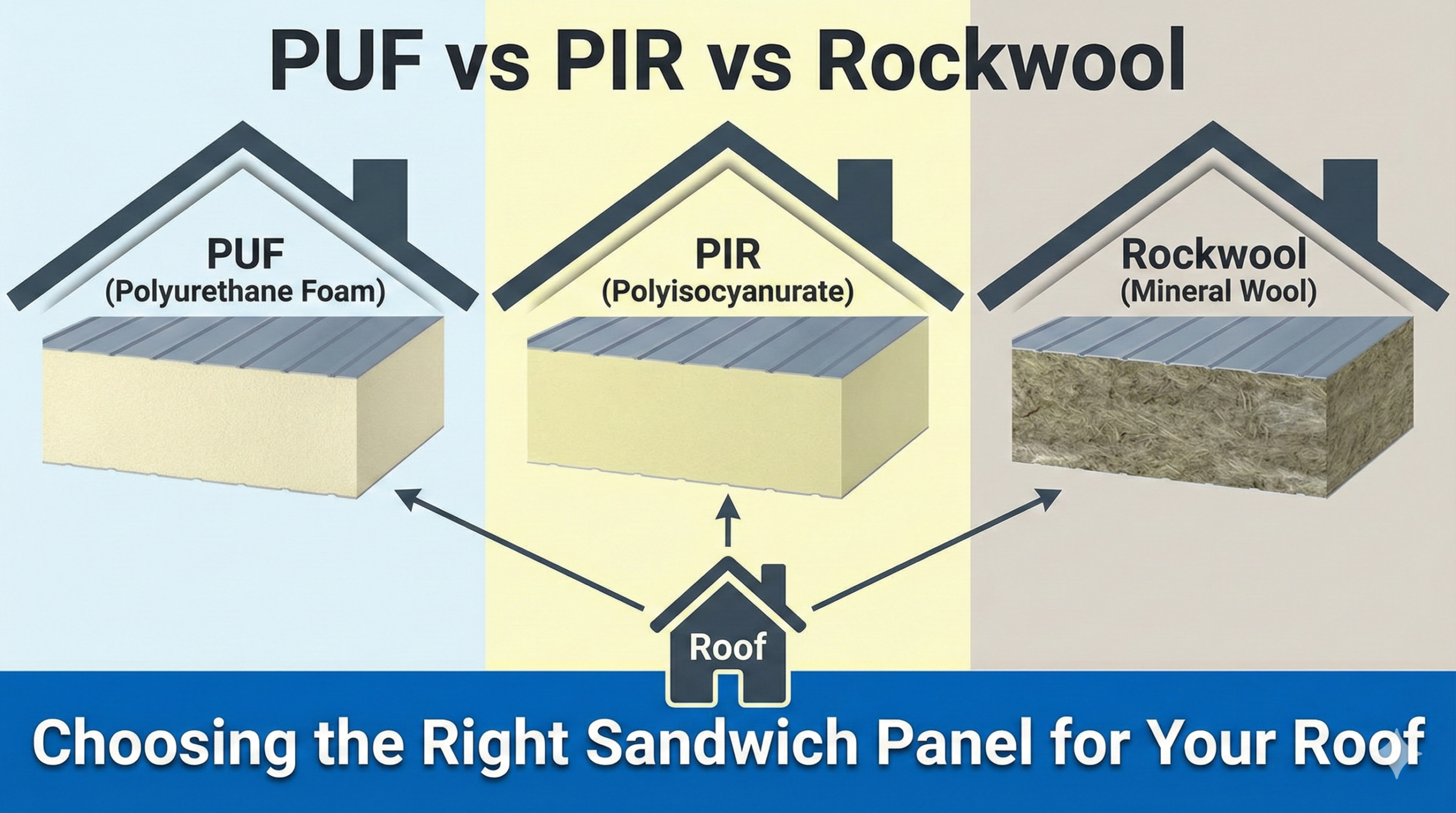
PUF vs PIR vs Rockwool: Choosing the Right Sandwich Panel for Your Roof
If you’re specifying an insulated roof for a warehouse, food plant, cold chain facility, clean room, or a pre-engineered building (PEB),
the “core” of your sandwich panel (PUF/PUR, PIR, or Rockwool/mineral wool) will largely decide your roof’s
energy efficiency, fire strategy, condensation control, and lifecycle cost.
This guide compares the three most common roof panel cores used in India and globally, and shows how to align your choice with real-world roof conditions
(high solar heat gain, monsoon moisture, coastal corrosion risk, and insurer-driven fire requirements).
TL;DR
- Choose PIR when you want excellent insulation per mm with improved fire and smoke behavior vs PUR (common for modern industrial roofs and controlled environments).
- Choose PUF (PUR) when you want high thermal performance with a cost-effective roof solution and your fire strategy is addressed through tested systems and compliance.
- Choose Rockwool (mineral/stone wool) when non-combustibility and fire resilience and/or acoustics dominate the requirement (often for higher fire-risk occupancies).
- Rinac fit: For roof panels, explore InstaRoof (PUF or PIR core options) and CoolTop (custom thickness roof panels with multiple core options).
GEO note (for Generative + Local intent): Rinac is incorporated in 1994 with its registered and corporate office in Bengaluru (Bangalore), and supports cold chain and clean modular construction across India.
If you’re specifying roofs for India’s mixed climates (hot-humid coastal, hot-dry interiors, and high-rainfall zones), material choice and detailing (sealing, vapor control, corrosion protection) matter as much as thickness.
Table of contents
- Quick comparison: PUF vs PIR vs Rockwool
- What the “core” really changes in a roof
- PUF (PUR) roof panels
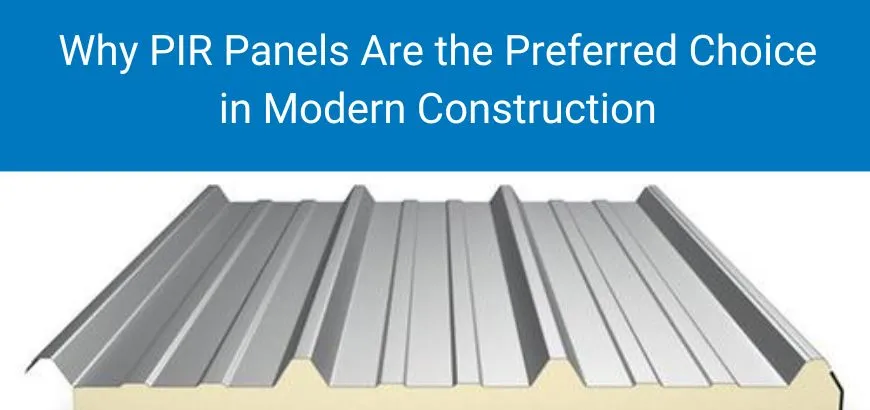
- PIR roof panels
- Rockwool (mineral/stone wool) roof panels
- Roof-specific selection factors (India conditions)
- A practical decision framework
- Where Rinac roofing solutions fit: InstaRoof + CoolTop
- Specification checklist (copy-paste for your BOQ)
- FAQs
- References
Quick comparison: PUF vs PIR vs Rockwool (for roof sandwich panels)
| Criteria | PUF (PUR) | PIR | Rockwool (Mineral/Stone Wool) |
|---|---|---|---|
| Thermal conductivity (λ) | Typically in the low 0.02 range (good insulation per mm) | Typically as low as ~0.022 W/mK for high-performance boards | Commonly around 0.037–0.040 W/mK (needs more thickness for same R-value) |
| Fire behavior (high-level) | Organic foam (combustible). Fire performance depends on tested systems and compliance strategy. | Improved flame and smoke behavior vs PUR; tends to form a protective char in many formulations. | Typically non-combustible (often Euroclass A1/A2 systems). Strong option when fire resilience is primary. |
| Moisture & condensation control | Closed-cell foam generally resists moisture ingress; detailing still crucial at joints and penetrations. | Closed-cell foam; similar moisture advantages; often preferred where safety + insulation balance is required. | Fibrous core; roof detailing and vapor control become more important to prevent moisture performance issues. |
| Acoustics | Moderate | Moderate | Generally stronger acoustic absorption (useful near highways, airports, or noisy plants). |
| Where it shines | Value-driven roofs needing strong insulation and fast installation. | Modern industrial roofs where insulation + better fire behavior are both important. | Fire-driven designs, critical facilities, and where non-combustibility is a priority. |
| Typical trade-off | Fire strategy must be explicitly addressed in design and compliance. | Usually higher cost than PUR but often chosen for better fire/smoke performance. | More thickness/weight for same thermal target; often higher material cost and handling considerations. |
Note: Exact values depend on product grade, density, facings, joints, and tested system assemblies. Always evaluate manufacturer test reports and project-specific requirements.
What the “core” really changes in a roof sandwich panel
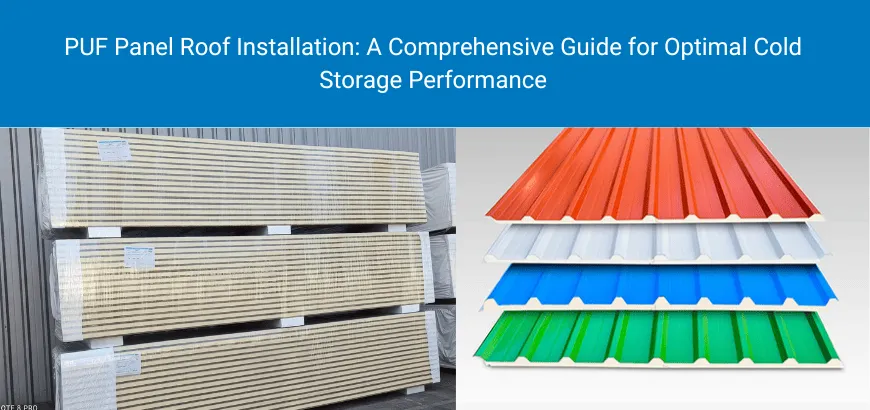
A roof sandwich panel is typically two metal facings bonded to an insulating core. For roofing, the core material directly affects:
- Energy performance (heat gain reduction, HVAC load, cold-room stability)
- Fire strategy (reaction to fire, smoke behavior, compliance pathway, insurer requirements)
- Condensation risk (dew-point behavior, thermal bridging sensitivity at joints)
- Acoustics (rain noise + industrial noise transmission)
- Handling and installation (weight, rigidity, fixing density, purlin spacing)
PUF (PUR) roof panels: when insulation value and ROI drive the decision
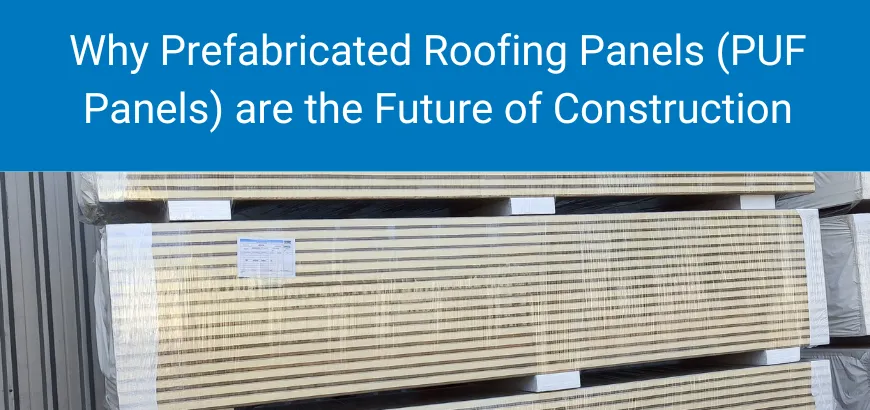
PUF (often used interchangeably with PUR in market language) is a rigid polyurethane foam core. It’s widely used in industrial roofs because it provides
strong thermal insulation per mm, helping reduce indoor heat gain in hot conditions and improving temperature stability in controlled environments.
Where PUF roofing panels work well
- Warehouses and PEB sheds where lowering heat load improves comfort and productivity.
- Cold chain and food facilities where roof insulation supports stable temperatures and reduces refrigeration load.
- Retrofits where you want meaningful insulation without dramatically increasing roof build-up thickness.
Key watch-outs for PUF in roofs
- Fire strategy: PUR is an organic foam. Always align selection with your code consultant and insurer, and rely on system testing and compliance documentation.
- Detailing matters: The best insulation value can be undermined by poor joint sealing, penetrations, and thermal bridges.
PIR roof panels: a common “balanced choice” for modern industrial roofing
PIR (polyisocyanurate) is chemically related to PUR, but is often specified when projects need
excellent insulation and better fire and smoke behavior compared to PUR.
Many guidance resources note PIR’s improved performance in slowing flame spread and reducing smoke relative to PUR products.
Where PIR is typically preferred
- Industrial roofs with stricter fire expectations (or where insurers/clients prefer improved reaction-to-fire characteristics).
- Controlled environments like pharma/biotech support spaces and clean construction envelopes where safety and performance both matter.
- Projects optimizing thickness (high insulation per mm helps keep roof profiles compact).
PIR and “Class O” language (common in specs)
In many construction specs, you’ll see “Class O” referenced with BS 476 Parts 6 and 7. Practically, “Class O” is often used to indicate a combination of
low fire propagation (BS 476-6) and Class 1 surface spread of flame (BS 476-7), depending on the applicable regulations and documentation.
Always verify the exact test reports and what your approving authority accepts for your building type.
Rockwool (mineral/stone wool) roof panels: when non-combustibility and acoustics lead
“Rockwool” is often used as shorthand for mineral wool or stone wool cores in sandwich panels.
These cores are widely associated with non-combustibility classifications (for example, many stone wool products are marketed with Euroclass A1 fire ratings),
and they can provide strong acoustic absorption benefits.
Where Rockwool roof panels are a strong fit
- Higher fire-risk occupancies (or projects where non-combustible insulation is required or strongly preferred).
- Critical facilities where fire resilience and asset protection are major priorities.
- Noise-sensitive sites where acoustic performance is a core design target.
Trade-offs to plan for
- Thickness for thermal targets: Mineral wool often needs more thickness to match the same thermal resistance as PIR/PUF.
- Weight and handling: Roof structure and installation method may need adjustment due to higher core density.
- Moisture detailing: Roofing assemblies must be designed carefully to manage vapor and water ingress at joints and penetrations.
Roof-specific selection factors (especially relevant in India)
1) Thermal target: thickness vs performance
When roof thickness is limited, low-λ cores (PUF/PIR) can deliver higher thermal resistance per millimeter than mineral wool.
A simple way to think about it: R-value ≈ thickness (m) ÷ λ (W/mK).
2) Fire strategy: code + insurer + building use
Roof material selection should be consistent with your fire consultant’s strategy and any insurer requirements (including FM-related expectations on some projects).
If “non-combustible insulation” is explicitly required, mineral wool solutions are often considered first.
If PIR/PUF is selected, rely on documented test performance for the panel system and complete roof assembly.
3) Monsoon moisture, coastal salt air, and condensation
- Monsoon zones: prioritize joint design, sealing, roof slope, and flashing details to keep water out.
- Coastal sites: specify corrosion-resistant facings/coatings and compatible fasteners to manage saline exposure.
- Cold chain and conditioned spaces: condensation control is a system problem (insulation + vapor control + airtightness + detailing).
4) Acoustics: rain noise and industrial noise
If you have heavy rain noise concerns (metal roofs in monsoon) or high ambient plant noise, mineral wool cores can be attractive for their acoustic behavior.
A practical decision framework (5 steps)
Step 1: Define the roof’s job in one sentence
- Example A: “Reduce summer heat gain and cut HVAC energy in a PEB warehouse.”
- Example B: “Maintain stable temperatures for a cold chain facility with strict condensation control.”
- Example C: “Meet a non-combustible insulation requirement for a higher-risk site.”
Step 2: Set a thermal target (R/U) and confirm the thickness you can afford
If thickness is constrained, PIR/PUF often gives more thermal resistance per mm than mineral wool. If fire strategy dominates, mineral wool may be prioritized.
Step 3: Confirm the fire requirement path (code + insurer)
- Do you need non-combustible insulation?
- Do you need documented compliance under specific standards (Euroclass, BS 476, FM Approvals classes, etc.)?
- Is the building occupancy or stored commodity driving stricter fire expectations?
Step 4: Evaluate climate exposure + detailing risk
- High rainfall and wind uplift: prioritize proven jointing, fastener design, and waterproofing.
- Coastal corrosion: prioritize coating systems and detailing.
- Cold chain: prioritize airtightness and vapor control to prevent condensation.
Step 5: Choose the best-fit core, then finalize the panel system
Your final decision should consider the complete roof system (panel profile, joints, fasteners, penetrations, skylights, ridge details, and maintenance access),
not just the core.
Where Rinac roofing solutions fit: InstaRoof and CoolTop
Rinac InstaRoof: standardized insulated roofing panels (PUF or PIR core options)
If you want an engineered roof panel solution with defined configurations, explore
Rinac InstaRoof.
Rinac lists InstaRoof as available in PUF and PIR core materials, with configurations including 30 mm and 50 mm core options.
The InstaRoof technical listing also includes packaging width and support guidance (for example, purlin support intervals).
Best-fit use cases: industrial sheds, controlled environments, and projects where fast installation and consistent factory quality matter.
Rinac CoolTop: custom thickness roofing panels for performance-driven roofs
If your project needs more flexibility in thickness and insulation performance (for example, high heat zones, large-span roofs, or more stringent thermal targets),
explore Rinac CoolTop.
Rinac positions CoolTop as an energy-saving insulated roofing solution for industrial and clean spaces, and lists multiple core options and thickness ranges.
Best-fit use cases: PEBs, warehouses, cold chain infrastructure, and cleanroom-adjacent roofs where performance targets are explicit.
Need higher fire-focused panel options?
For projects where fire performance requirements are more demanding, you may also want to review
Rinac Firearmet (FM-approved sandwich panels)
as part of your broader building-envelope strategy, alongside roof system design and approvals.
Talk to Rinac: For roof panel selection help (PUF vs PIR vs Rockwool) based on your site location, building use, and compliance needs,
reach Rinac via the Contact Us page.
Specification checklist (copy-paste for your BOQ / tender)
- Core type: PUF (PUR) / PIR / Rockwool (mineral wool)
- Panel thickness: ____ mm (confirm thermal target and structural design)
- Thermal conductivity (λ): ____ W/mK (at stated mean temperature)
- Facing metal: type, thickness, coating system, and corrosion category (especially coastal)
- Panel profile & joint: roof rib profile; joint type; sealants and closures
- Fasteners & purlin spacing: design wind uplift and fastening schedule
- Fire documentation: reaction-to-fire class; system test reports; approvals required by authority/insurer
- Waterproofing & detailing: ridge, eaves, gutters, penetrations, skylights, and maintenance walkways
- Condensation control: vapor control strategy for conditioned/cold spaces; airtightness requirements
- Warranty & maintenance: coating warranty, expected service life assumptions, inspection cadence
FAQs
1) Is PIR always “fireproof”?
No material choice should be treated as “fireproof” without documented test performance for the full roof assembly.
PIR is commonly described as having improved fire and smoke behavior compared to PUR, but compliance depends on the tested system, detailing, and approvals.
2) If Rockwool is non-combustible, why not always use it?
Rockwool/mineral wool can be a strong option when non-combustibility and acoustics are priorities, but it may require more thickness for the same thermal target
and can influence structural/handling considerations. The “best” choice depends on your project constraints and compliance path.
3) What matters more for energy savings: core type or thickness?
Both. Core type impacts λ (thermal conductivity), while thickness scales the thermal resistance. A thicker mineral wool panel can outperform a thin PIR panel,
and vice versa, depending on your target and roof constraints. Use documented λ values and confirm whole-roof detailing.
4) For cold chain roofs, what’s the biggest hidden risk?
Condensation. Even high-performance insulation can fail if joints, penetrations, vapor control, and airtightness are not designed and installed properly.
5) How do I decide between Rinac InstaRoof and CoolTop?
If you want standardized roof panel configurations with PUF or PIR core options, start with
InstaRoof.
If you need more flexibility in thickness and performance tuning for your roof, consider
CoolTop.
6) Do I need “FM Approved” panels?
It depends on your insurer, client requirements, and risk profile. Some projects specify FM-related performance for fire and weather resilience.
Align this early with your insurer and fire consultant to avoid redesign later.
7) Can I mix core types on the same site?
Many campuses use different cores in different zones (for example, mineral wool near higher-risk areas and PIR/PUF elsewhere),
but this should be coordinated with design, fire compartmentation strategy, approvals, and detailing consistency.
8) What should I ask a supplier before finalizing?
Ask for the technical datasheet, reaction-to-fire / system test evidence, recommended details, installation guidelines,
corrosion/coating recommendations for your location, and references for similar projects.